One of the unexpected side effects of being a Realtor is accidental time travel.
Most people only visit the 1980s when a song comes on the radio or somebody mentions a Trapper Keeper.
I visit the 1980s several times a month.
All I have to do is open the right front door.
As Realtors, we walk through a lot of houses. Most have been updated a little over time. New paint. New flooring. Maybe a kitchen renovation somewhere along the way.
But every now and then I step into a home that has remained gloriously, stubbornly committed to an earlier decade.
And just like that, I'm eight years old again.
The first clue is usually the carpet.
Not carpet in a bedroom. That's normal.
I'm talking about carpet in places where carpet had absolutely no business being.
Around toilets.
Next to bathtubs.
Sometimes wrapped completely around an entire bathroom like somebody looked at a damp environment and thought, "You know what this room needs? More fabric."
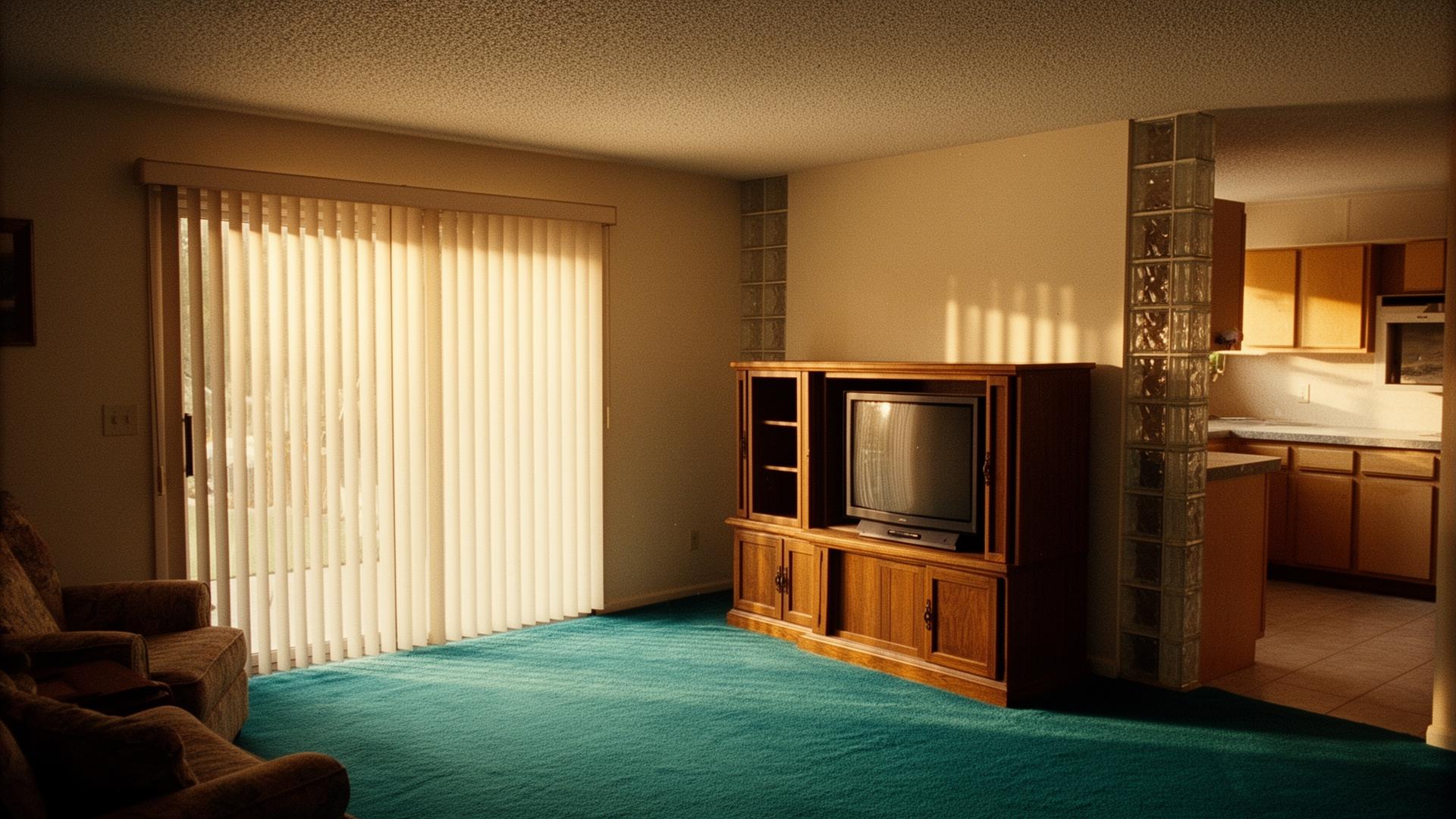
Bonus points if it's teal.
Double bonus points if there's a matching fuzzy toilet seat cover.
Triple bonus points if decorative soaps shaped like seashells are involved.
Nobody was ever allowed to use those soaps.
Their purpose remains a mystery.
Popcorn Ceilings
An entire generation collectively agreed that the ideal ceiling texture should resemble cottage cheese fired from a leaf blower.
For years nobody questioned it.
Builders installed it. Buyers accepted it. Life moved on.
Today homeowners spend thousands of dollars removing it, which feels a little like paying to erase photographic evidence of a questionable haircut.
Vertical Blinds
And speaking of questionable choices, let's discuss vertical blinds.
If you grew up in the 1980s, you remember the sound.
That distinctive clack-clack-clack every time somebody opened the patio door.
By year five, several slats were missing.
By year ten, the remaining slats had turned a mysterious shade of beige.
Nobody replaced them.
Televisions Disguised As Furniture
The real luxury homes of the era often featured another status symbol: giant televisions disguised as furniture.
Young people today will never understand the commitment required to own one of these things.
The television itself weighed approximately the same as a midsize pickup truck and lived inside an elaborate wooden cabinet that occupied an entire wall.
Some even included a record player and cassette deck.
Families gathered around these entertainment centers like they were altars.
Children were warned not to touch them.
Fathers spent entire weekends trying to improve the reception by adjusting antennas and muttering things under their breath.
And somehow we all survived with three channels.
Glass Blocks
Another thing I still find in houses today is the occasional collection of glass blocks.
The 1980s absolutely loved glass blocks.
Need a bathroom wall?
Glass blocks.
Need a window?
Glass blocks.
Need a way to make your basement bar feel sophisticated?
Believe it or not, glass blocks.
For a brief period in American history, we became convinced that stacking translucent squares everywhere was the height of elegance.
I still encounter them often enough that I can only assume a warehouse somewhere is still trying to get rid of inventory.
Formica Countertops
Of course, no discussion of 1980s homes would be complete without mentioning Formica countertops.
When those countertops were new, homeowners treated them like luxury finishes.
Then somebody set down a hot pan.
Or chipped an edge.
Or discovered that water and particle board are not natural friends.
Suddenly the dream began to unravel.
The Encyclopedia Britannica
But perhaps my favorite surviving artifact from the decade isn't a decorating trend at all.
It's the Encyclopedia Britannica.
Every so often I'll find an entire matching set sitting proudly on a bookshelf.
Twenty-four beautifully bound volumes of information that represented the internet before the internet.
When I was growing up, owning a set of encyclopedias meant your parents were serious about education.
Today we carry more information in our pockets than those books contained collectively, but I still smile whenever I see them.
Maybe because they remind me of a time when the answer to every question wasn't available in three seconds.
The Funny Thing
The funny thing about all these old trends is that they weren't bad.
Not really.
At least not at the time.
They were simply people doing exactly what we're doing now: decorating their homes in ways they thought looked current, stylish, and maybe even a little impressive.
That's what makes me laugh when I walk into an untouched 1980s house.
Somewhere, forty years ago, somebody stood in that teal bathroom admiring their matching carpet, fuzzy toilet cover, and decorative soaps and thought:
"This place is perfect."
And honestly?
For a little while, it probably was.